GLiNER2.5-Decide
Introduction
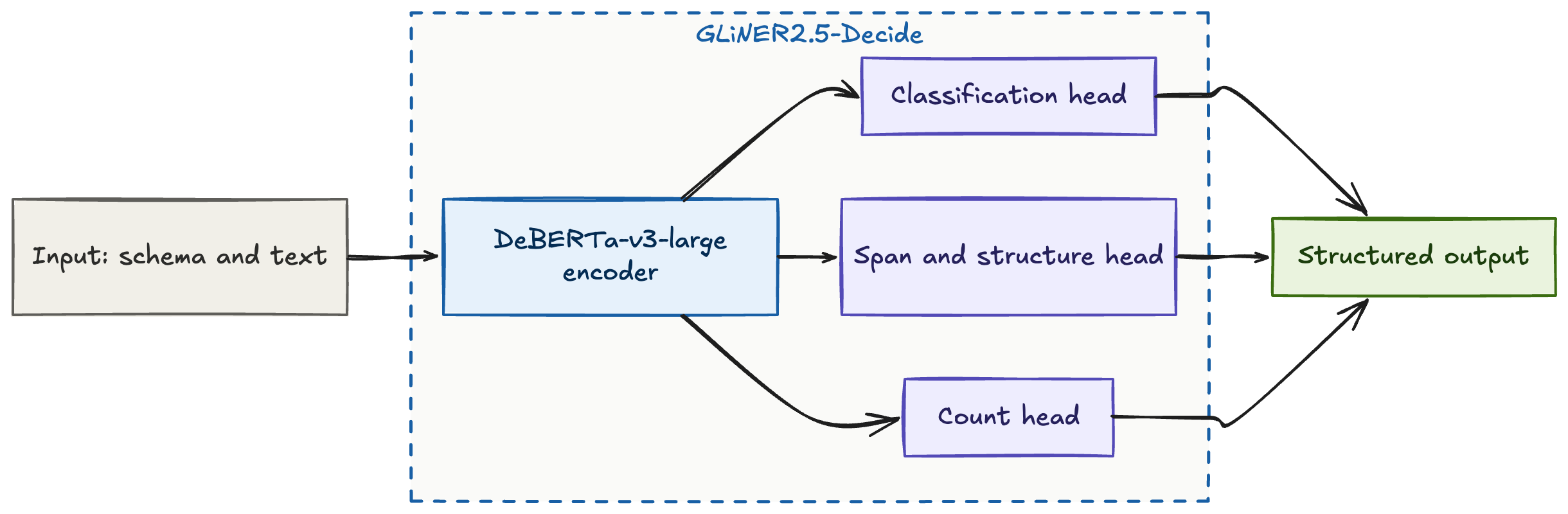
- GLiNER2.5-Decide is Fastino’s open-weight decision model in the GLiNER2 family: one DeBERTa-v3-large encoder (~435M parameters total) with schema-conditioned heads for classification, NER, structured records, relations, and constrained multi-field routing.
- It is not a decoder LLM. Inference scores label candidates encoded in the input sequence, with no token-by-token generation.
- Python SDK: GLiNER2 (
AutoExtractor,classify_text,batch_classify_text). Docs: Fastino GLiNER-2.5-Decide | Paper. - For a hosted System One API with similar use cases, see Jev. For QQP benchmarks and LoRA fine-tuning that closes the accuracy gap with Jev, see the blog post.
Architecture overview
GLiNER2.5-Decide is a single encoder, multiple heads design. A DeBERTa-v3-large stack reads one joint sequence built from your document text and a task schema (field names, label options, span types, and relations). The encoder does not emit open-ended text; it produces contextual vectors for every token, and task-specific heads read out structured predictions at schema marker positions.
- Schema in the sequence: The SDK serializes the task into special tokens (for example
[P]for a property or task slot,[L]for a discrete label option, and separators such as[SEP_TEXT]before the raw text). Because the label vocabulary lives in the input, there is no fixednum_labels=Nlinear layer tied to one training setup. You define new fields and label strings at inference time as long as they fit the model’s token budget. - Shared backbone, routed heads: The same weights support classification, NER / span extraction, structured records, relations, and richer multi-field schemas. Each mode uses the encoder output at the indices the preprocessor recorded for that schema shape.
- Structured answers only: The model chooses from the labels and fields you put in the schema. It does not generate open-ended text like a chat LLM.
Classification example
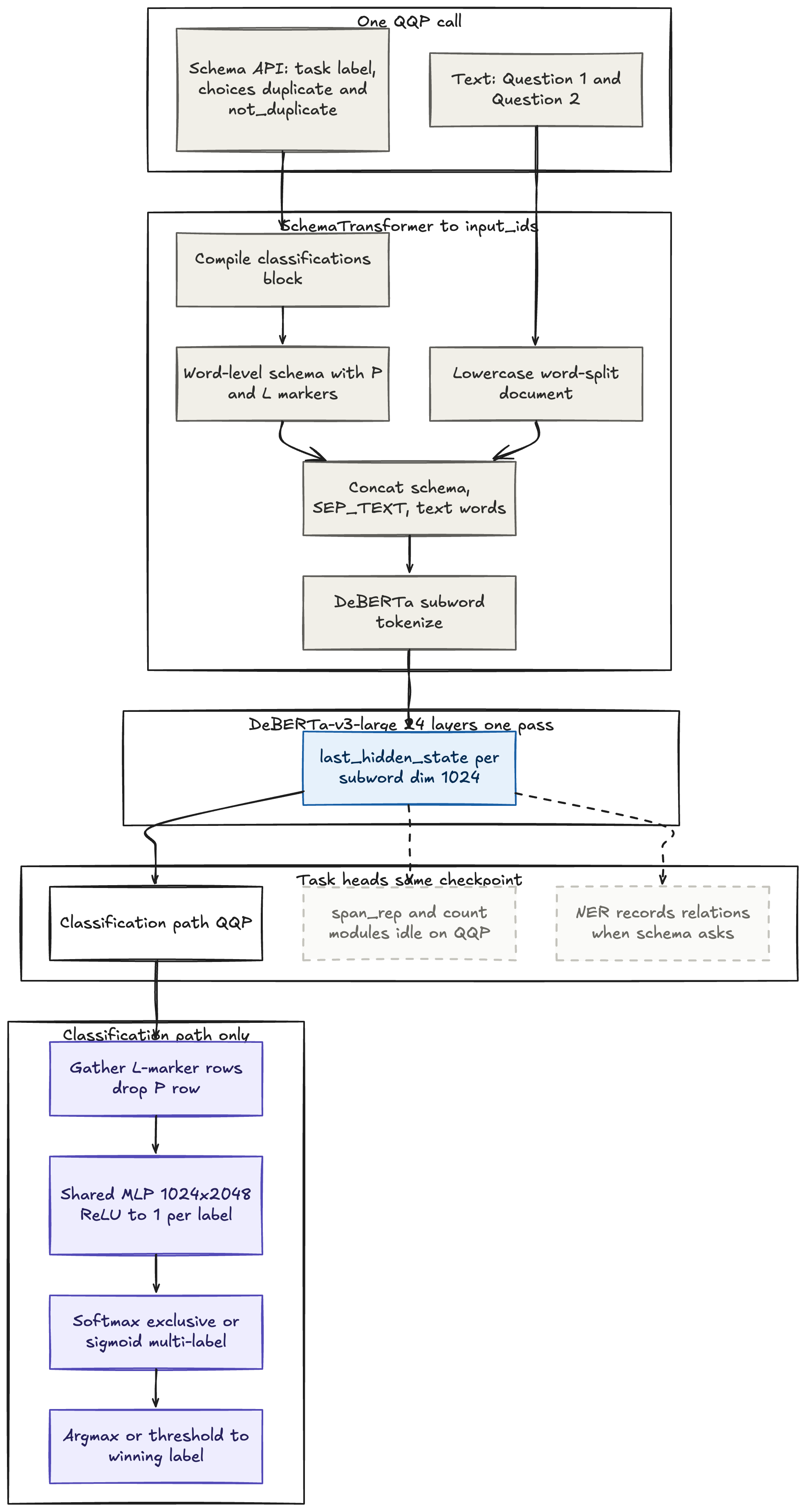
The most common entry point is classify_text: you pass a string (or batch) and a task map from field names to lists of label strings. The library turns that into a schema prefix, appends your text, runs the encoder, and applies the classification head.
- Tokenize the combined schema + text with the DeBERTa tokenizer.
- Encode the full sequence; each subword gets a hidden state (1024-d for DeBERTa-v3-large).
- Gather hidden states at each
[L]token (one row per candidate label for that field). - Score each row with a shared MLP (
hidden → 2×hidden → 1logit per label). - Decide with softmax over logits when labels are mutually exclusive, or other losses during training for multi-label fields.
Duplicate detection on question pairs is a minimal two-label task. The schema prefix might look like:
( [P] label ( [L] duplicate [L] not_duplicate ) ) [SEP_TEXT] question 1 : … question 2 : …
The winning label is argmax over the two logits at the [L] positions (optionally returned with confidence via include_confidence=True).
Code example
1 2 3 4 5 6 7 8 9 10 11 12 13 14 15 16 17 | |
Batch inference: batch_classify_text with the same task schema.
Comparison with BERT and Jev
| BERT pair classifier | Jev | GLiNER2.5-Decide | |
|---|---|---|---|
| Deployment | Local | Hosted API | Local (open weights) |
| Labels | Fixed head | NL criteria in request | Schema strings in-sequence |
| Output | Fixed logits | Typed + calibrated | Finite schema candidates |
| Generation | No | No | No |
| Zero-shot new tasks | Weak | Strong (API) | Built for new schemas |
| Internals public | Yes | No | Yes |
Fine-tuning
- Use
gliner2.training.ExtractorTrainerwithInputExample+Classificationtargets; LoRA on the encoder is the lightweight default (adapter-only checkpoints). - Separate learning rates for encoder and task heads are typical. Training still builds text + schema batches; loss is classification BCE / softmax on label logits.
- For a single two-label task (such as QQP), training and inference are just softmax over those two logits. Larger multi-field schemas use the same text-plus-schema setup with more fields.
Details and QQP numbers: GLiNER2.5-Decide QQP fine-tuning blog.
References
[1] GLiNER2.5-Decide: Hugging Face | Fastino docs | GLiNER2 repo
[2] GLiNER2 paper: arXiv:2507.18546
[3] System One API counterpart: Jev