Jev (TypeSafe System One)
Introduction
- Jev is TypeSafe’s System One model — named after Kahneman’s Thinking, Fast and Slow: fast, structured decisions instead of open-ended generation.
- You provide a state (facts needed for the decision) and a set of questions; the API returns typed, calibrated answers ready for business logic — not prose to parse.
- Jev runs as a hosted API (closed weights). For a local open-weight alternative in the same niche, see GLiNER2.5-Decide and the QQP fine-tuning walkthrough.
Note
TypeSafe’s launch post: Introducing System One models and Jev.
Question types
| Type | Role | Typical output |
|---|---|---|
choice |
Pick one of several options | Discrete label |
score |
Numeric rating on a rubric | Calibrated score |
noul |
Yes/no as a probability | Class and probability in \([0, 1]\) (threshold at 0.5) |
Instructions for each question are natural-language criteria; the model scores against them without generating a chain-of-thought essay.
Architecture (conceptual)
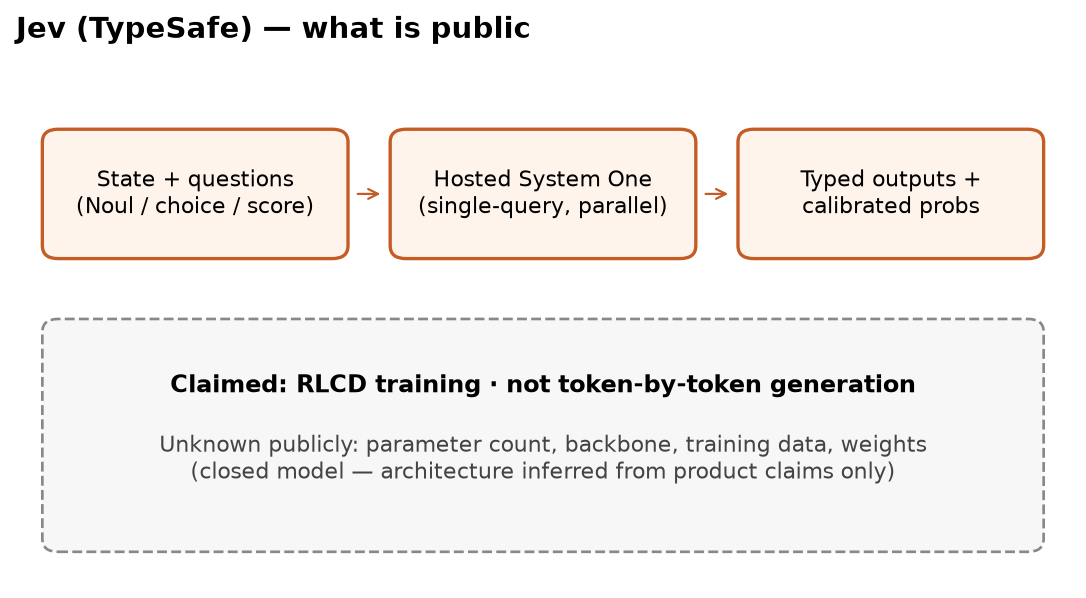
- Unlike chat LLMs, Jev is built for decisions over a finite output space defined per request (choices, scores, or noul probabilities).
- Internals are not public; treat it as an API-first structured decision service rather than an inspectable encoder checkpoint.
Minimal example (duplicate detection)
1 2 3 4 5 6 7 8 9 10 11 12 13 14 15 16 17 18 | |
When to use Jev
- Strong zero-shot structured decisions when you are fine with network latency and API billing (input tokens only on current pricing).
- No local GPU or no appetite to fine-tune an open encoder.
- Privacy allows sending state to a third-party API.
Compare latency and local deployment tradeoffs in the GLiNER2.5-Decide QQP blog.
References
[1] Jev — Product site | TypeSafe blog
[2] Related local model — GLiNER2.5-Decide